
Using AI is not the same as changing the way you work with AI.
January 6, 2026 | SKYWARE INSIGHT
The terms AI and AX come up often in business today. The two concepts may look similar, but they mean different things.
If AI is the technology that performs or supports work, AX is the use of that technology to improve existing ways of working and automate the processes that need it.
Diagram · Key Terms
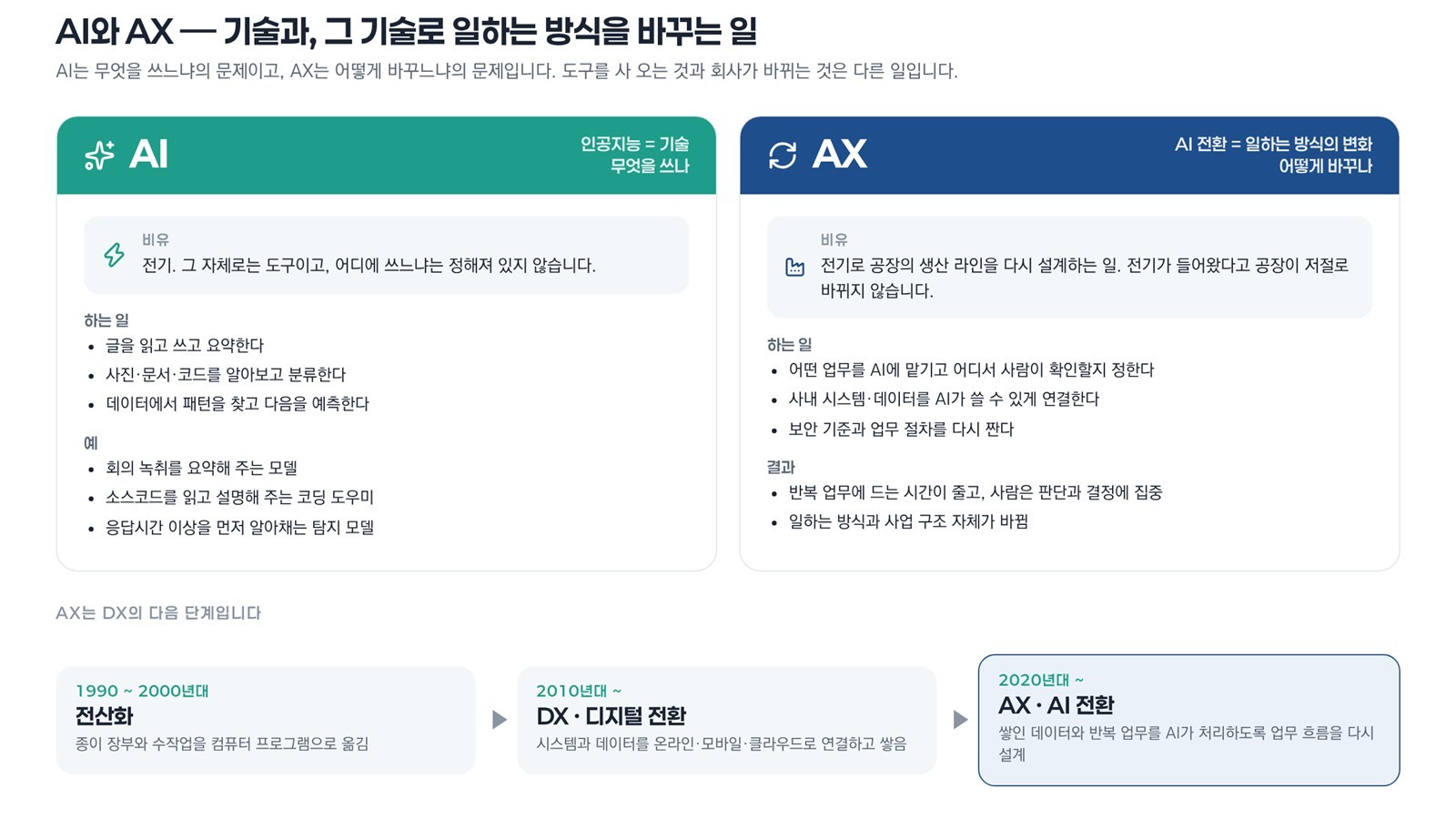
AI vs. AX
AI is a question of what you use; AX is a question of how you change the way you work.
Analogy
It is like electricity. Electricity itself is a tool, and what it is used for is not predetermined.
What it does
- Reads, writes and summarizes documents
- Analyzes and classifies images, documents and code
- Finds patterns in data and makes predictions
Examples
- A model that summarizes meeting transcripts
- A coding assistant that reads and explains source code
- A model that detects response-time anomalies
Analogy
It is like redesigning a factory’s production line around electricity. Bringing in electricity does not transform the factory on its own.
What it does
- Decides which tasks to hand to AI and where people should review
- Connects in-house systems and data so AI can use them
- Redesigns security standards and work procedures
Outcomes
- Less time on repetitive tasks, so people can focus on judgment and decisions
- Ways of working and operating structures change
AX is the next step after DX
- 1990s-2000sComputerizationPaper ledgers and manual work moved into computer programs
- 2010s onwardDX · Digital TransformationSystems and data connected and accumulated online, on mobile and in the cloud
- 2020s onwardAX · AI TransformationWorkflows redesigned so AI handles accumulated data and repetitive tasks
Same AI, different results: the meeting minutes example
| Step | With AI tools alone | With AX |
|---|---|---|
| Meeting ends | The person in charge collects the recording | The recording is collected automatically |
| Transcription · Summary | Paste the transcript into AI and AI summarizes it | Transcribed and summarized automatically |
| Capturing decisions | The person in charge picks out decisions from the summary | AI extracts decisions, owners and schedules |
| System entry | Entered manually into the management system | Automatically queued for registration |
| Review · Approval | No defined procedure · Left to individual discretion | The PM reviews and approves |
| Notifying owners | Each owner is notified separately | Notified automatically upon approval |
| Human touchpoints | 4Methods may vary by person | 1Focus only on review and approval, with every project run the same way |
Done by people AI · Automated
AI Is the Technology; AX Is the Change in Work
AI (Artificial Intelligence) is technology that performs a wide range of tasks, such as analyzing data, writing documents and generating source code. ChatGPT and Claude, which we use every day, and Claude Code for developers are all AI-powered tools.
These tools can cut the time spent writing documents or analyzing code. However, using AI tools does not by itself change the way work is done as a whole.
AX (AI Transformation) goes one step further. It is the process of examining which parts of existing work can be automated and connecting AI to in-house systems and data to improve workflows.
The key is not simply adopting AI, but using AI to cut unnecessary steps from existing work and build a structure for working efficiently.
The Same AI Can Deliver Different Results
Take writing meeting minutes as an example.
When using an AI tool, the person in charge feeds the recording into the AI after the meeting to create a summary. They then review the content and either enter it into the project management system manually or pass it on to the relevant people. Writing the minutes takes less time, but the follow-up work is still handled by people.
With AX, by contrast, the workflow itself can change. When the meeting ends, the transcript is organized automatically and AI extracts the key decisions and follow-up tasks. This information is linked to the project management system, registered after review and approval by the person in charge, and delivered to the relevant team members.
Of course, implementing this requires more than AI: it also takes integration with existing systems, data processing and a well-designed approval process.
Both approaches use AI, but the difference is clear. If using AI makes individual tasks more convenient, AX improves the entire workflow those tasks belong to.
Why SKYWARE Is Focusing on AX
Understanding AI technology alone is not enough for a company to pursue AX. You also need to look at how existing systems are structured, what data is used and at which stages human review is needed.
For example, ERP systems, e-commerce platforms and messaging systems accumulate a wide range of business data. Connecting this data to AI makes it possible to analyze operations or automate repetitive data processing and reporting tasks. However, since each system has its own data structure and work procedures, real-world adoption requires a design tailored to each environment.
Drawing on its experience in enterprise software development and system implementation and operation, SKYWARE is focusing on exactly these areas. We currently use Claude Code in our development work, building hands-on experience while identifying where AI can support real-world tasks.
Building on this experience, we plan to connect existing enterprise systems with AI and develop automation approaches suited to each client’s work environment.
In the End, the Work Matters More Than the Technology
Every company has a different work environment and different problems to solve. Not every task needs AI, and automation does not always produce better results.
That is why, before adopting AI, it is worth first examining which tasks currently take the most time, which tasks are repetitive and whether automating them would deliver real benefits.
AI is the technology that supports work; AX is the process of using that technology to change the way we work.
SKYWARE focuses less on the technology itself and more on how to apply it to real work.