
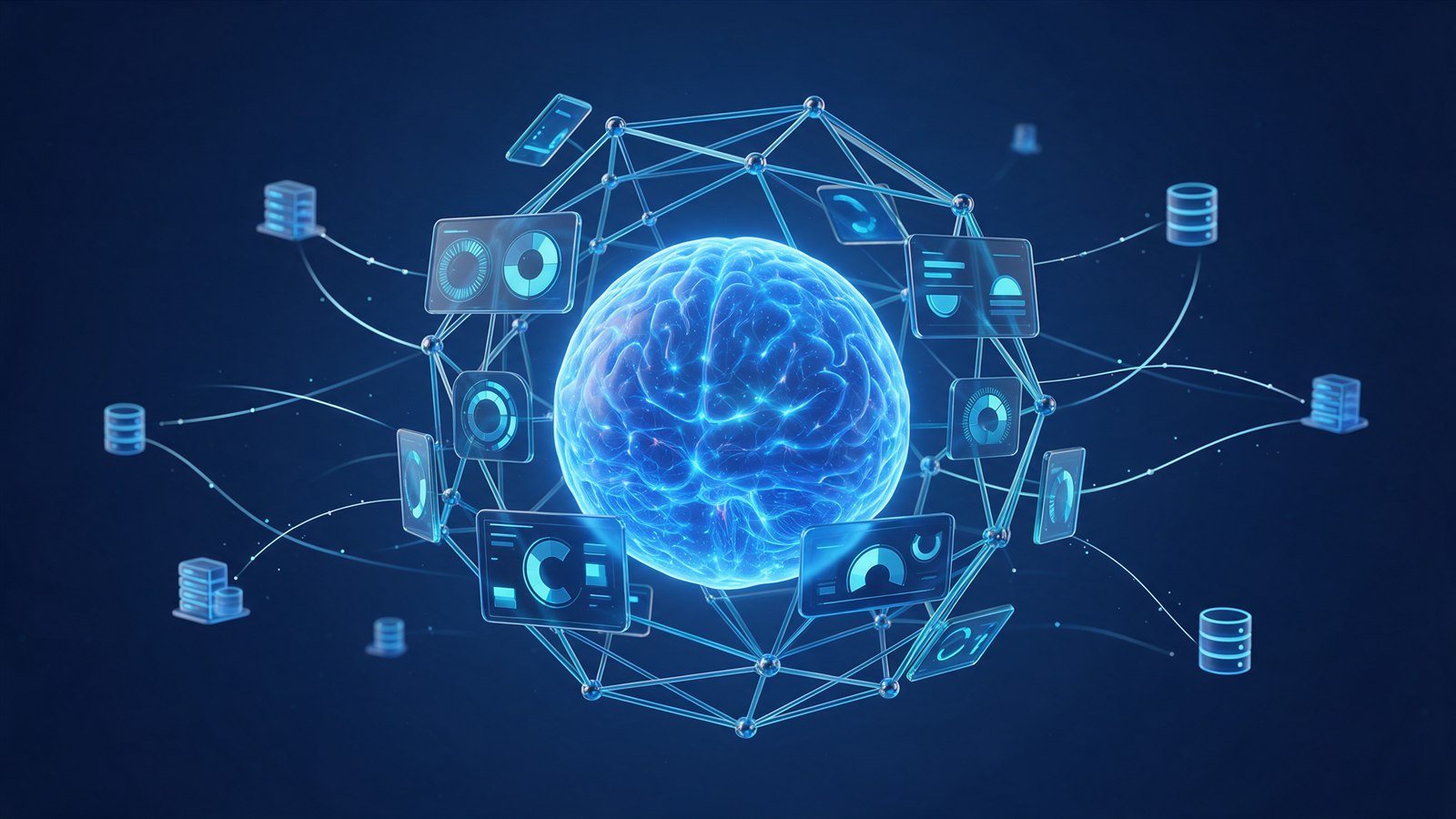
If the AI model is the brain, the harness is the execution management system that lets that brain use tools and get work done while preventing it from taking the wrong actions.
October 10, 2026 | SKYWARE INSIGHT
A harness is the software structure that enables AI agents to perform real work and manages and controls how that work is executed. There is a clear reason why the term agent harness has been coming up so often in the AI industry lately: even with the same model, results differ from company to company, and most of that difference arises outside the model.
Originally, a harness is the tack fitted to a horse. It transfers the horse’s power to a cart while steering it and bringing it to a stop. An agent harness does the same job. It connects the model’s reasoning ability to real business systems, determines where to go and stops it where it should not go.
01. The AI Model, the Harness and Business Systems
An enterprise AI agent consists of three layers: the AI model on top, the company’s business systems at the bottom and the harness in between. The model understands, reasons and plans, but cannot execute anything on its own. Business systems hold data and functions, but cannot understand natural language. The harness is what connects the two and exercises control between them.
AI Agent Harness
The execution and control layer between the model and business systems
- Least privilegeGrants only the permissions needed
- Approval gatesPrior approval for critical tasks
- Audit logsRecords every execution
- Execution isolationA secure sandbox environment
- Prompt injection defenseBlocks malicious input
Business tool integration and execution
- ERPEnterprise resource planning
- CRMCustomer management
- DBDatabase
- MessagingInternal communication
- CommerceOrders · Payments · Products
Key point: What matters is not just AI performance, but a structure that executes and controls real work safely.
02. Why the Harness Matters · Through a Single Resend
Suppose you ask an AI agent, “Analyze today’s customers whose messages failed to send and resend them.” The AI model can plan what needs to be done, but the actual execution of the work is managed by the harness.
- 1. Retrieve send logsPulls today’s send results and error codes from the unified messaging system. The harness opens only the “read” tool.
- 2. Analyze failure causesClassifies failures as carrier rejections, invalid numbers or opt-outs. This is the step that relies most on the model’s judgment.
- 3. Separate targets and exclusionsSplits resend targets from opted-out customers. The harness prevents the model from altering the opt-out list.
- 4. Check permissions and conditionsThe harness checks send limits, permitted sending hours and user permissions. Even if the model says “it’s fine,” execution stops if conditions are not met.
- 5. Resend after approval by the person in chargeBulk sends run only with a human approval token. Each approval request includes the number of recipients and the rationale.
- 6. Record and verify resultsRecords which tool was called with which input and what the result was, then rechecks the delivery success rate.
Throughout this process, the harness prevents the AI from sending bulk messages without approval or accessing customer information it is not authorized to see. However, these safeguards must actually be implemented in the harness. Simply using a harness does not automatically guarantee security. An instruction like “Do not send without approval” is a prompt, not a harness, and prompts can be fooled.
03. A Technology Directly Tied to AI Security
A harness is a security mechanism before it is a convenience. Most of the elements discussed in AI security come down to which part of the harness they are implemented in.
Diagram 2 · Security elements and the role of the harness
| Security element | Role in the harness | Where it is implemented |
|---|---|---|
| Least privilege | Restricts the APIs and data AI can use | Tool definitions · MCP server permissions |
| Execution approval | Applies approval procedures to critical tasks such as payments, sends and deletions | Approval points · Approval token checks |
| Prompt injection response | Distinguishes the trustworthiness of external input and blocks risky execution | Input source labeling · Pre-execution checks |
| Execution isolation | Handles file and command execution in a restricted environment | Sandbox · Working directory restrictions |
| Audit logs | Records AI tool calls and execution results | Call records · Result verification loop |
In 2026 in particular, how to control permissions and the scope of execution in the harness, not just the performance of AI models, is being treated as a key design challenge for enterprise AI agents. When the U.S. NIST published a concept paper covering AI agent identity, authorization, access delegation and logging, and when Gartner cited inadequate risk controls as a major reason agentic AI projects get canceled, both were ultimately talking about the harness.
04. What We Focus On from SKYWARE’s Perspective
When you connect SKYWARE’s experience in building enterprise systems with our AI and AX business, the harness emerges as a central technical concept. In connecting commerce, messaging and ERP systems with AI models, we can design systems so that the harness manages the execution of real work while existing systems verify data access and permissions. Those who built the system are best placed to draw the lines on which tools to open and where to place approvals.
A close-to-home example is Claude Code, the coding agent our development team uses. The harness is not the model itself but the structure around it. The work loop of reading and editing files, running tests and fixing again on failure; approval points that pause before risky commands to get human confirmation; execution isolation that keeps work from leaving the working directory; and a work history that records what was changed are all functions of the harness.
SKYWARE found the same thing while using Claude Code in its development work. Deciding when to run tests and where people review production deployments changed the results more than which model we used. The model stayed the same, but refining the harness changed the outcome.
Attention is shifting from how smart an AI model is to how reliably and controllably AI performs real work.
The competitiveness of an AI agent starts with the model but is completed by the harness. The question companies should ask when adopting agents must also shift from “Which model do we use?” to “How do we structure the management of execution and permissions?”