
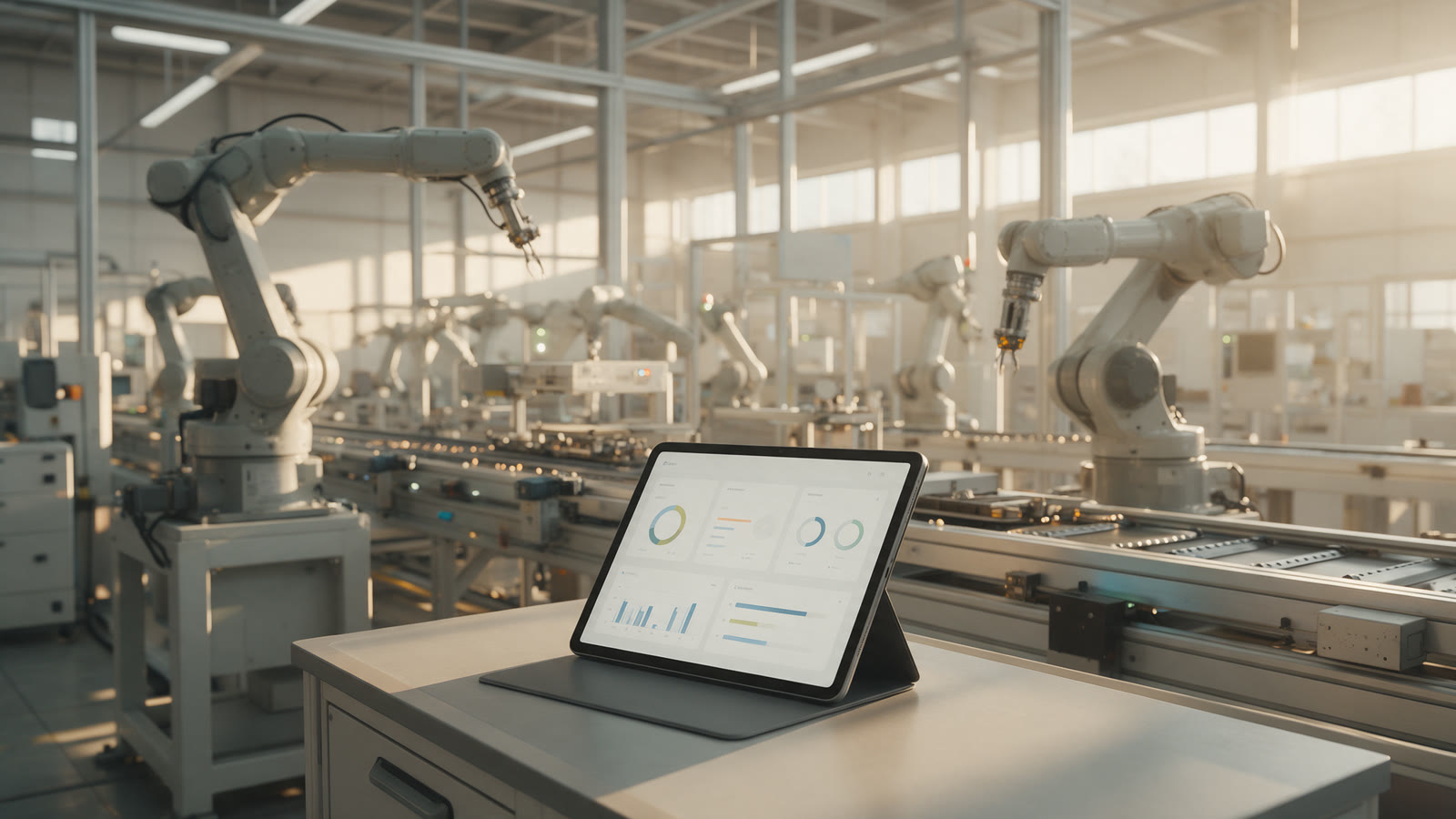
This is not about robots and AI factories. It is about redesigning the work that runs every day (purchasing · materials · equipment · quality · delivery) so that AI can handle it.
October 13, 2026 | SKYWARE INSIGHT
AI transformation (AX) in manufacturing has moved to the center of government policy. Korea’s Ministry of Trade and Industry announced plans to deploy 500 AI factories by 2030 under its M.AX strategy, which combines manufacturing with AI, and in September 2026 it reported that 170 sites that had adopted M.AX saw productivity improve by 30% and defect rates fall by 15%. The Ministry of SMEs and Startups has also moved beyond smart factory deployment, setting “AI-based autonomous factories” as a policy goal.
For manufacturers on the ground, however, and especially for mid-sized companies and SMEs, this news can feel distant. A factory where robots run on their own sounds like an investment worth tens of billions of won. AX for manufacturers does not have to start on the production line. It can start with the work people still run by hand every day: buying materials, counting inventory, inspecting equipment, adjusting delivery dates and communicating with suppliers. This article explains why, and in what order.
01. Manufacturers Lose More Time Outside the Factory Floor
Production lines are already highly automated. Work outside the line, by contrast, still runs on phone calls, Excel and messengers. Materials staff cross-check the inventory system against purchase order emails every morning, equipment staff fill out inspection logs by hand, purchasing staff receive quotes by email and copy them into Excel, and sales picks up the phone to call the production planner every time a delivery inquiry comes in.
These tasks have three things in common. They repeat every day, they require people to gather information scattered across multiple systems (ERP · MES · purchasing · messengers), and any delay can stop the line or cause a missed delivery date. This is exactly where AI agents deliver results first. AI gathers, cross-checks and drafts; people review and decide.
Diagram 1 · A Manufacturer’s Daily Work, Today and After AX
| Task | Today | After AX | What people do |
|---|---|---|---|
| Materials · consumables purchasing | Check inventory → request quotes by email → compare in Excel → internal approval → place order | AI suggests order timing and quantities based on inventory and consumption trends, compares quotes and drafts the approval request | Approve |
| Equipment inspection · maintenance | Handwritten logs · repair after breakdown | Flags early signs of anomalies from sensor and operating data and proposes inspection schedules along with parts inventory | Carry out inspections · make judgments |
| Delivery date inquiries | Sales → calls production planner → replies | AI checks production plans, inventory and shipping status to answer expected delivery dates immediately and sends automatic notices when they change | Negotiate exceptions |
| Supplier communication | Purchase orders, deliveries and inspection results communicated individually by phone or email | Automatically sends order confirmations, delivery requests and inspection results by SMS, KakaoTalk and email, and collects replies | Disputes · coordination |
| Quality · defect reporting | Compile inspection data → write weekly report | Aggregates inspection results by line and process and drafts a report covering anomalies and likely causes | Confirm causes · countermeasures |
02. Why Now · Three Reasons
Diagram 2 · Three Reasons Manufacturers Need AX
- PeopleVeterans are leavingOrdering criteria and equipment inspection know-how walk out the door with retirees. The system, not individuals, needs to remember them
- CostMaterial costs change every quarterMonthly inventory adjustments are too slow. Purchasing needs to be re-planned weekly based on consumption trends
- Customers“When will it ship?” needs an instant answerWhile you make calls to find out, the order goes to another company. One lookup should be enough to get the answer
AI gathers and organizes+People review and decide=More orders handled with the current team
Of the three, people are the most urgent. The government even runs a program to preserve the know-how of master craftspeople nearing retirement as data. Experience such as “if this machine makes this sound, check the bearings” or “this supplier’s deliveries slip at the end of the month” exists only in the heads of the people doing the job today. That knowledge must be written into the system as inspection criteria and ordering rules before those people leave the company, and AX is what makes AI apply those recorded criteria every day.
03. The Data Already Exists. It Is Just Scattered
The industry cites the scarcity of well-built data on manufacturing sites as a prerequisite challenge for autonomous manufacturing. That is true, but there is no need to be intimidated. Even mid-sized and small manufacturers already have order, receiving and inventory history in their ERP, operating and defect records in their MES or production logs, quotes, contracts and tax invoices in their purchasing systems, and supplier message logs in their messaging systems. The problem is not a lack of data, but that it sits in separate systems and cannot be seen all at once.
That is why the first step in manufacturing AX is not collecting new data, but connecting existing systems so that AI can read them. Standards such as MCP, which expose enterprise systems to AI as standard tools, have recently become established, greatly reducing the cost of connecting ERP, purchasing and messaging systems one by one. At the same time, companies must decide which data to open up and which actions (order confirmation, supplier notifications) require approval.
04. Where to Start · Five Steps of AX for Manufacturers
SKYWARE Proposed Model
Five Steps of AX Transformation for Manufacturers
- 01AssessRepetitive work · Where data lives
- 02DesignStarting with purchasing · delivery
- 03ValidatePoC on one item · one line
- 04IntegrateERP · MES · messaging integration
- 05EnhancePerformance measurement · Permission control
- Purchasing · procurement automationOrder timing suggestions for MRO (maintenance, repair and operations) supplies, quote comparison, approval drafts, and integration with e-contracts and tax invoices. This is the area where results show up in numbers the fastest.
- Supplier messagingAutomatically sends purchase orders, delivery requests, inspection results and payment notices by SMS, KakaoTalk and email, and collects replies. Time spent on phone calls drops immediately.
- Delivery · inventory inquiriesAI responds to sales inquiries by checking production plans and inventory and answering with expected delivery dates, so customer inquiries no longer go to production staff.
- Equipment · quality reportingAggregates operating and inspection data to draft daily reports covering early signs of anomalies and likely causes. Staff can focus on review and countermeasures.
Order matters. Starting with a big initiative such as predictive maintenance can mean a year spent on installing sensors and cleansing data. The path that avoids failure is to start with work like purchasing, procurement and supplier messaging, where the data is already in the system and the impact can be measured immediately in processing time and volume, confirm the results, and then expand to equipment and quality.
05. How SKYWARE Can Work with Manufacturers
SKYWARE has built and operated MRO solutions that digitize manufacturers’ purchasing and procurement. The structure handles everything from purchase requests to approval, ordering, e-bidding and e-contracts, delivery, tax invoices and settlement in a single flow, integrated with ERP. Adding AI on top creates purchasing AX, where AI takes over the preliminary steps of decisions people used to repeat every day, such as order timing suggestions, quote comparison and approval drafts, while people handle approval.
For supplier communication, the unified messaging solution sOMP can automatically send order, delivery and inspection notices through the appropriate channel, and for delivery and inventory inquiries, an AI chatbot can be set up to answer by querying core business systems. All of these connections begin with understanding the data structures and permission frameworks of existing ERP and MES systems. This is where SKYWARE’s more than 20 years of experience building and operating enterprise systems comes into play.
AX for manufacturers is not about bringing in robots. It is about redesigning the purchasing, delivery and supplier work that people used to run by hand every day, so that AI handles it and people can focus on judgment.
References: Ministry of Trade and Industry M.AX strategy and September 2026 announcement of results at M.AX adopting sites (Seoul Shinmun, September 11, 2026); Ministry of SMEs and Startups support direction for AI-based autonomous factories (2026 outlook); reports on data-building challenges for autonomous manufacturing (May 2026). Performance figures are based on government announcements.